HVAC Integration: The Past

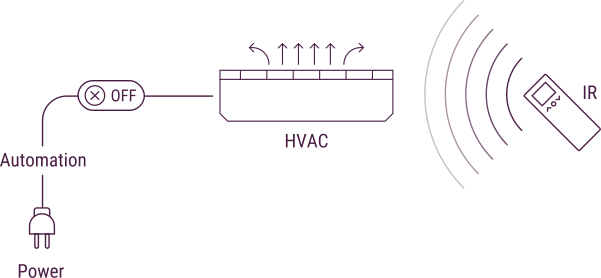
Early air conditioning systems were purely mechanical, with minimal electrical components- just enough to enable basic operation. They offered no capability for external control or integration. Control was limited to physically interrupting the power supply to turn the system on or off.

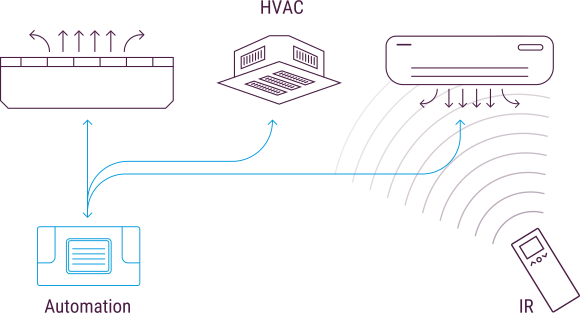
As compact split systems entered the market, a new control method emerged: infrared (IR). Home automation platforms could capture and replicate IR command sets, allowing them to operate split systems by emulating the original handheld remote. While this approach remained inherently one-way, with no system feedback or status verification, it represented a meaningful step forward compared to simple power cycling.

Later, the widespread adoption of communicating thermostats introduced more advanced control possibilities. However, these devices were primarily deployed as stand-alone solutions rather than as part of broader automation or building management environments.

Stay Connected
Sign up for our monthly newsletter to receive news and updates

HVAC Integration: The Present

These days, the widespread adoption of inverter-based HVAC systems has fundamentally changed the integration landscape.

On one hand, traditional integration methods such as power cut-off control and communicating thermostats have largely become obsolete, as inverter systems are designed to operate continuously and modulate capacity dynamically, making simple on/off control ineffective and, in many cases, detrimental to performance and reliability.

On the other hand, inverter operation relies on significantly more advanced electronic control architectures that involve continuous data exchange among indoor units, outdoor units, sensors, valves, and controllers. As a result, a wide range of operational and diagnostic data is now available.

This shift creates both a major opportunity and a significant challenge for HVAC integration.

The opportunity lies in the fact that system behavior is fully digitized. Because HVAC components communicate continuously, it is, in principle, possible to access rich operational data, including temperature sensor readings, operating mode, system status, compressor activity, electronic expansion valve position, alarms, and faults.

The challenge is that this data remains internal to the HVAC system. Communication protocols are proprietary and manufacturer-specific, which makes them inaccessible to third-party platforms by default. While some manufacturers offer their own gateways, these typically address only a narrow set of integration requirements and are often limited in scope or flexibility. There is still no industry-wide communication standard that enables consistent, brand-agnostic HVAC integration.

To summarize, over time, several HVAC integration approaches have emerged:

  • Dry contact interfaces, enabling basic on/off control with little or no feedback.
  • Infrared control, providing remote command emulation without system visibility.
  • Manufacturer-provided gateways, commonly based on protocols such as LonWorks or BACnet.
All of these approaches remain dependent on specific brands, models, and system architectures. Despite decades of evolution, a truly universal solution that supports all HVAC equipment still does not exist.

That is, until CoolAutomation came into the picture.

CoolAutomation gateways, including CoolMaster and CoolPlug, connect directly to HVAC systems and interface with them natively. They provide a consistent, unified interface for communication with automation, BMS, and management platforms while retaining the flexibility required to reflect the full operational capabilities and constraints of modern HVAC equipment.

HVAC Integration: The Future

So what lies ahead for HVAC integration? Several trends are already evident today.

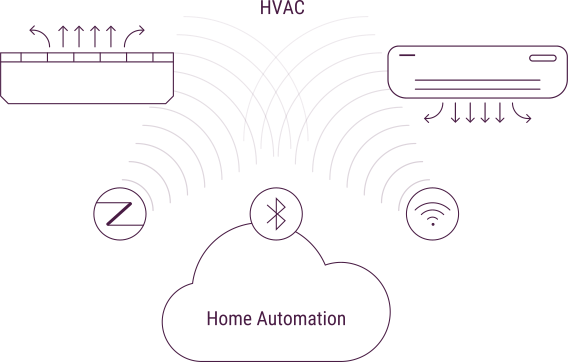
Primarily driven by the rise of IoT, HVAC manufacturers have begun embedding wireless connectivity into their equipment, most commonly through Wi-Fi, and pairing it with proprietary cloud platforms and mobile applications. This process will likely expand to include additional wireless technologies such as Zigbee, Z-Wave, and Bluetooth.

However, these developments are primarily focused on stand-alone control experiences. Manufacturer efforts tend to prioritize direct user interaction through branded apps rather than deep, open integration with external automation, management, or analytics platforms. As a result, wireless connectivity alone does not inherently solve the integration challenge.

That said, with wireless connectivity becoming standard across HVAC equipment, new integration approaches will inevitably emerge. As communication becomes less reliant on closed, wired buses, opportunities arise for easier access, remote data aggregation, and scalable integration architectures.

Reach out to learn more about HVAC integration solutions:

Contact Us

Igor Mitbarg
Igor Mitbarg · Co-Founder and VP Services
With more than 20 years of engineering experience and deep expertise in VRF systems, HVAC control, and HVAC integration, Igor offers authoritative insights grounded in deep technical knowledge.