Wireless Hvac Control for Your Smart Home
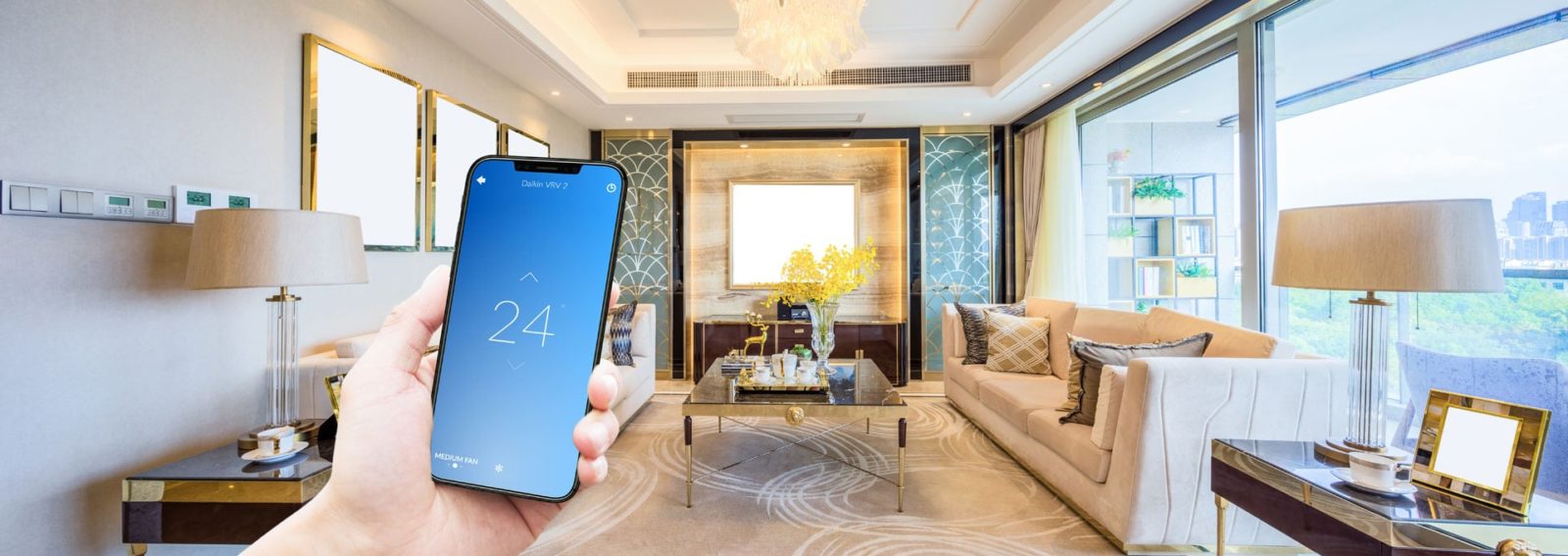

There are many different technologies that allow you to control your Air Conditioning system remotely. In this article we will focus on the WiFi HVAC systems. We will analyze different concepts, comparing their advantages and weak points.
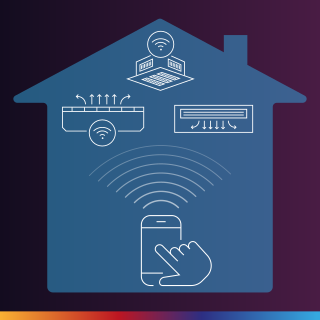
Local WiFi devices can be operated by smartphones within the local WiFi network, using native apps, developed by the manufacturer of the air conditioning system. Such HVAC systems won’t be controllable once the smartphone is out of the range of the local WiFi network.
Such a concept will work for some home appliances, such as TV, and Audio-Video devices, that require control only when we are around. There is no need to access them while we are away. However, when considering air conditioning systems, it is essential to have remote access while we are not home. (e.g. left the house and forgot to turn the air conditioning off).
Another disadvantage of local WiFi networks are interruptions in the network connectivity. Once the phone is set for WiFi, it can automatically switch to another WiFI network (without any notification), and the air conditioner is not accessible anymore.
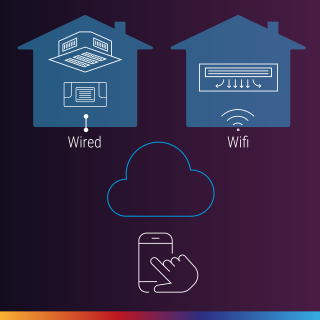
When remote access is required, cloud-based technology fulfils this need. All the data can be hosted locally, at the client’s location, or on any of the modern internet cloud storage providers (e.g. Amazon Web Services [AWS]).
The main idea behind the cloud is that you can access all your information over the internet end device – in our case, the Air Conditioning system – must have a proper Internet connection, through WiFi or wired connection to the local network with internet access or 4G.
With cloud service, having an internet connection means there is a reliable remote control that works from anywhere.
Cloud services offer many more benefits, such as better security and easy software updates with zero infrastructure maintenance.
The only downside to cloud services is that they are dependent on the reliability of the Internet connection. However, with the growth of the IoT market, internet technologies are becoming more reliable – as it is now a must-have for any device in the IoT world.
Using the “cloud” concept, it really doesn’t matter how the Air Conditioning system is connected to the Internet, as long as we have the ability to turn the air conditioning on remotely – prior to getting home from work; or turn it off remotely if we forget to shut it down when we are out of the house.
At CoolAutomation, we firmly believe that at this point, wired internet connection of the HVAC unit can provide better results, being less sensitive to the stability of the local WiFi networks.
Our CoolMasterNet and CoolPlug platforms connect a wide range of HVAC brands and models to our Cloud service, the HVAC Control solution. This provides our customers with the simplest experience of controlling their HVAC equipment remotely and reliably.
Contact us to find out about our Cloud-based Air Conditioning control solutions! Contact Us